THE
WARNER HOUSE IN IPSWICH
This post will be in two parts beginning with the earliest Warner house in Ipswich and then following the family as they take up residence in Gloucester on Cape Ann where they continued to be blacksmiths and built more houses.
The Town of Ipswich refers to this house as the Ephraim B. Harris house, named after the man who moved the ancient house to his land in the 19th century and added onto it. For this post, focusing on the Warner family, we will refer back to its beginnings on Market Street and call it the Warner house.
The Warner family was a
family of blacksmiths. In the 17th century they made their home in
Ipswich. Their house was located on what is now Market Street just about where
Bank Ipswich is located today. It was probably a one cell house, having
one room down and one chamber above with a big chimney at one end with a small
entry. It was probably a typically modest house for the period like many others.
This very early house stood at this site until the 19th century.
Some say it was built in 1696. This may well be correct.
At this time the house
was moved by a builder, Ephraim B. Harris, to the corner of Mineral and Central
Streets. Central Street had not been laid out so that the address of the house
was on Mineral Street, an early street originally called Baker's Lane, and remains so today at 22 Mineral Street. The
gable end of the house faces Mineral Street with the formal front door facing High
Street and the back door facing Central Street. Actually I believe
Abner Harris located the house in his own back yard as the house he lived in was on
the corner High Street and Mineral Street. Newer houses now separate
Abner Harris's homestead from this house.
|
||

In the new location
an addition was made to the old house with a Greek Revival front door and
staircase. To the left of the new front entry were two new rooms, one up and
one down with fireplaces in a new chimney for a total of four fireplaces in the
house. The rooms in the early part of the house were very large, a clue
to the age of the house.
Across the ceilings in
the early side of the house was a huge summer bean with a flat chamfer and
lamb's tongue chamfer stop. There was evidence that the summer beam had even been
wallpapered to make it disappear at a time when it was not fashionable to have
exposed beams showing in the more refined rooms of the later period.
 |
| Here is the great early summer beam with a flat chamfer and lamb's tongue chamfer stop. Notice the heavy framing in the corner, |
Holes in the old plaster
offered a peek at early riven laths...short strips of oak attached with
handmade rose head nails.
 |
| This photo shows just a little of the early riven lath holding the original plaster. Riven lath is short strips of oak attached with rose head nails. The summer beam is rough with bits of wallpaper, whitewash and old paint. |
Many years passed until
the house entered the 20th century. At this time a family consisting of a widow with children,
lived in the house until eventually only one member of that family was left living here.
She had very limited means and the house became run down. This lone
occupant lived on the second floor. The house was an eyesore surrounded
by chain link fencing. Behind the house, almost on the property line, was an
enormous tree. It was a really huge tree.
In 1997 when everyone
thought spring was just around the corner there was a surprise April Fool's Day
snowstorm. At the height of the storm down came the big tree right on top
of the house threatening to sever the house into two parts. The occupant
was sitting in her second floor kitchen. Her life was only spared by the
huge oak frame, specifically the summer beam, of the old house which stopped the downward momentum of
the great tree right over her head, saving her life. Rescue crews carried
her out without even her slippers on her feet never to return as an occupant. I regret that I do not have a photo of the huge tree hanging over the house. It was an unforgettable sight.
 |
| This is the upper side of the house facing High Street with a formal Greek Revival door and surround and crushed roof. |
Now I, the old house
Realtor in town, inherited the tough assignment of selling the crushed house.
It took a long time to clean out the house. Some of the neighbors
demanded that it be razed.
Happily, that never
happened. A builder bought it and put the old house back together. The roof on the house had been replaced by Ephraim Harris and was not as
steep as it should have been for a first period house. With that in mind
the new owner decided to gain more living space from the new attic by creating
a much steeper roof. The roof had to be replaced anyway. The pitch is now
higher than it ever was but it made the small house much more livable. After
the almost demolition of the house it sold for a mere $68,000, an unheard of
low price in a high priced marketplace. After restoration it sold for
$345,000 and later for $395,000 as it has been transformed from a crushed
derelict to an attractive first period house.
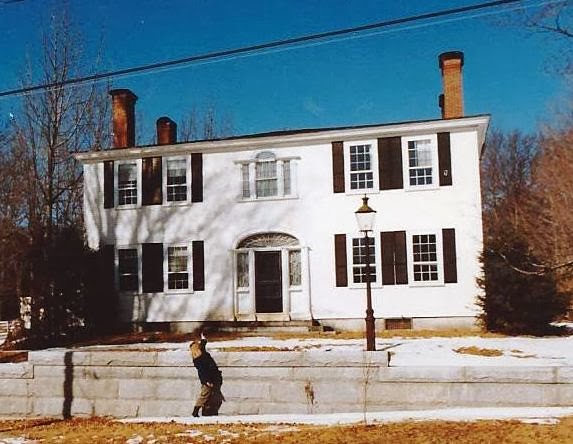
Here is what Massachusetts Historical Commission wrote about the house in 1978. This photo was taken at that time.
 |
| The house in 1978. Frequently houses that are moved are placed on a higher foundation than in their original settings.
Richard Sutton and others sold to housewright, Ephraim B. Harris, a house and land on December 30. 1820. (Book 233, Page 148). Harris built two more houses on this land, one of which survives situated on the corner of Mineral and Central Streets.
Originally the front facade faced north, but today the principal entrance is on the south facade. The north entry has a Greek Revival door frame, including corner blocks, recessed panels and sidelights.
This door frame is very similar to an Asher Benjamin design found in his pattern book, The Practice of Architecture, published in 1833. The design was described by Benjamin as "suitable for a house of moderate size, or where the story is not sufficiently high to admit a fanlight over it or where a fanlight is not desired.
Harris may have been familiar with Benjamin's pattern book, and seems to have used it as a model when decorating his own house.
A definite slope in the roof and the uneven bay arrangement suggest that the house was built in two sections and Waters supports this theory. Evidently Harris was commissioned by Capt. Robert Kimball to build a new house on his market Street lot. The lot was already occupied by an old dwelling house built by Daniel Warner prior to 1666. Harris removed a portion (if not all) of this house to his own land on Mineral Street, and enlarged it with a new Greek Revival section. A summer beam running from girt to girt with a chamfer is a remaining first period feature in the earliest, western half of the house. Simple Greek Revival details include the northern side."
It is not uncommon to arrive at an incorrect construction date. The deeds follow the land and the mention of a dwelling house on a piece of land does not necessarily mean that it the same house that is on the land at a later date. There may well have been a very early house on Market Street in 1666 but most likely not this house.
|
|
||
Meanwhile, the Warners made a move
to Gloucester where they continued to be blacksmiths living right in the
heart of the Harbor Village as the neighborhood around the harbor was
referred to in the 18th century.
In my next post you will read the
story of their houses in Gloucester. You are not going to believe what
happened in Gloucester! Drama surrounds the old houses of the Warner
family.
Thanks for reading.
Pru
The former owner of this house after restoration, Al Boynton, has kindly left a link to his photos. Here is the link. I think you will enjoy them. http://www.flickr.com/photos/snowlight/sets/72157615000254804 |